Young Children in Boosters: An Essay
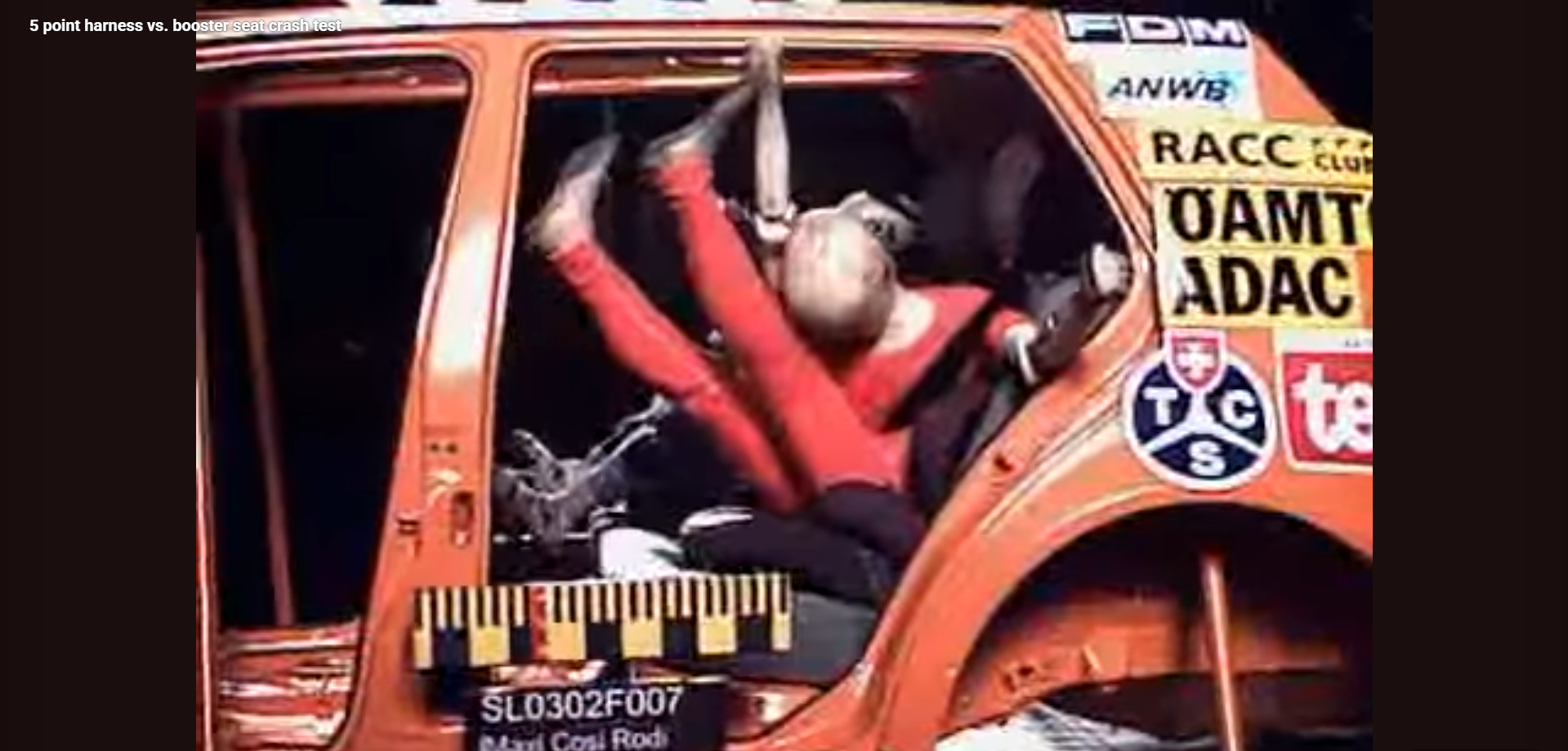
A still image from the video below, demonstrating the difference between a booster seat using the adult seatbelt and a forward-facing harnessed seat.
The Harness to Booster Transition: Why Children Should Remain Harnessed Until at Least Five Years Old
Introduction
Transitioning a child from a forward-facing harnessed car seat to a belt-positioning booster is one of the most significant and most debated steps in child passenger safety. While many booster seats advertise minimum weights such as 15 to 18 kg, these manufacturer thresholds do not reflect developmental readiness, musculoskeletal maturity, or behavioural capability. Across New Zealand, Australia, and Europe, evidence strongly supports keeping children in harnessed restraints well past three years old, with most safety agencies recommending at least five years old before considering a booster.
This paper examines scientific, biomechanical, and policy evidence, focusing exclusively on the harness-to-booster transition, arguing that children should remain in harnessed restraints as long as they fit them.
1. Harnessed Restraints as the Appropriate Preschool Age Standard
New Zealand
New Zealand law requires that children use an approved and appropriate child restraint until at least their seventh birthday, but best practice bodies clarify that appropriate means remaining in a harnessed seat until outgrown. Safekids Aotearoa and Plunket describe harnessed seats as the primary restraint for toddlers and preschoolers and state that boosters are designed for older, school-aged children with more developed motor control and posture stability.
Australia
Australian best practice guidelines from Neuroscience Research Australia emphasise that forward-facing harnessed restraints should be used until a child fully outgrows them, which often occurs between four and eight years, depending on the seat. The Australian Standard AS or NZS 1754 supports extended ranges for harnessed seats specifically to delay the transition to boosters.
Europe
Reports from the European Road Safety Observatory classify harnessed seats as suitable for younger children still needing restraint of the torso and pelvis, and boosters as the next developmental stage reserved for school-aged children. European injury data repeatedly proves worse outcomes when children who still fit harnessed seats are prematurely moved to boosters.
2. Crash and Injury Data Supporting Extended Harness Use
NHTSA Booster Effectiveness Study
The most robust large-scale crash analysis of booster use found that children aged three and four placed in boosters had higher injury rates compared with those in harnessed seats, and premature booster use increased the risk of injuries ranging from non-disabling to fatal by up to 27%. This study directly compares the two restraint types and demonstrates that harnessed seats offer superior protection for younger children.
Australian Crash and Hospital Data
The New South Wales Child Death Review Team has repeatedly reported that a significant proportion of seriously injured three-to-five-year-olds were not using harnessed restraints despite still meeting size requirements for them. This reinforces the problem of early graduation.
European Crash Investigations
European accident reconstruction studies document cases of preschool-aged children in boosters suffering abdominal organ lacerations, lumbar spine flexion injuries, and submarining under the belt. These injuries were associated with insufficient pelvic maturity and poor posture control, problems not present when a five-point harness is used.
3. Biomechanical Rationale for Keeping Children Harnessed
A booster seat does not restrain the torso; it positions an adult seatbelt. A harnessed seat, by contrast, distributes crash forces across the shoulders, chest, and hips, limits forward head excursion, stabilises the torso laterally, and prevents slumping, rotation, and submarining.
Key Biomechanical Problems in Three and Four-Year-Olds in Boosters
Immature pelvis. The iliac crests of three-to-four-year-olds are poorly developed, causing the lap belt to migrate upward into the abdomen.
High head-to-body ratio. Young children exhibit greater forward head excursion.
Short femurs and seating posture. Preschoolers cannot bend their knees naturally at the seat edge, causing slouching.
Weak core musculature. They lack the endurance to maintain an upright posture for an entire journey.
A harness compensates for all of these limitations; a booster does not.
4. Behavioural Maturity: The Most Important Factor
A booster is only safe if the child can sit upright for the entire ride, avoid leaning forward or sideways, keep the belt in the correct position, stay awake without slumping, and resist impulse-driven movement. Preschool-aged children cannot reliably meet these expectations.
Misuse Data
A major observational study from the University of Michigan found that 64.8% of booster-seated children misused the belt, placing it behind their back, under their arm, or allowing excessive slack. These misuse behaviours dramatically increase injury risk. Harnessed seats have far lower misuse consequences because the system itself limits posture changes.
5. Expert Recommendations, Harness to at Least Age Five
New Zealand
SitTight, the country’s leading child restraint education provider, states, “I would be unlikely to consider a booster until a child is at least 18 kg and four and a half to five years old.” Safekids Aotearoa encourages parents to keep children harnessed as long as they fit.
Australia
NeuRA and Kidsafe recommend extended harnessing and warn against relying solely on manufacturer minimum requirements to determine booster readiness.
Europe
European consumer and safety organisations categorise boosters as appropriate for school-aged children, not preschool-aged children.
Conclusion
Children should remain in forward-facing harnessed restraints until at least age five, and ideally until they have fully outgrown the harness by height or weight. A three-year-old, even one who meets a booster’s minimum stated weight, lacks adequate skeletal maturity, posture control, behavioural readiness, and biomechanical compatibility with a belt system. Crash data, biomechanical research, and expert guidance from New Zealand, Australia, and Europe all show that premature booster use places preschool-aged children at significantly higher risk of severe injury. The safest practice is to keep children harnessed as long as the seat allows.
References
Safekids Aotearoa. “Booster Seats Position Paper.” https://www.safekids.nz
Neuroscience Research Australia. “Best Practice Guidelines for the Safe Restraint of Children Travelling in Motor Vehicles.” https://www.neura.edu.au/crashlab/child-restraints
European Road Safety Observatory. “Protective Equipment, Child Restraints.” https://road-safety.transport.ec.europa.eu
National Highway Traffic Safety Administration. Booster Seat Effectiveness Estimates Based on CDS Data. https://www.nhtsa.gov/sites/nhtsa.gov/files/811338.pdf
NSW Child Death Review Team. “Annual Reports on Child Road Trauma.” https://www.ombo.nsw.gov.au
ANEC. An Accident Study of the Performance of Restraints Used by Children in Cars. https://www.anec.eu
Safekids Aotearoa. “How Does a Booster Seat Protect Your Child.” https://www.safekids.nz
Klinich, Kathleen D., et al. “Observations of Misuse of Child Restraints.” University of Michigan. https://deepblue.lib.umich.edu
SitTight Child Restraint Education. “When Should My Child Move to a Booster.” https://www.sittight.co.nz
Kidsafe Australia. “Car and Road Safety for Children.” https://www.kidsafe.com.au
ADAC Child Restraint Testing Programmes. https://www.adac.de